
Contents
What Behavioral Science Reveals About Shared HabitsApplying These Principles With or Without a PartnerA Small Relational Cue Can Change the Entire YearNew Year resolutions appear each winter with the same sense of possibility. Yet the pattern is familiar: early motivation fades, schedules shift, and new habits lose their structure. Behavioral science points to a clear explanation for this drift—resolutions created and maintained in isolation are more fragile than those supported by another person.
Consistency is not only a matter of discipline. It often reflects the presence of subtle social cues: being seen, being accompanied, or simply being aware that someone else is moving in the same direction.
What Behavioral Science Reveals About Shared Habits
Social cues amplify consistency
People tend to repeat behaviors more reliably when they know someone else may notice. This quiet form of social facilitation helps transform a personal goal into an action that feels anchored in the environment.
Shared expectations lighten self-regulation
Goals are easier to maintain when they are not carried alone. Mutual expectations create an external scaffold, reducing the cognitive effort required to track, monitor, and recommit.
Visible habits stabilize faster
Private intentions often fade quickly. Habits become more stable when they enter a visible space—acknowledged, tracked, or recognized by another person. Visibility adds clarity: a beginning, an end, and a reason to continue.
Motivational signals create synchrony
A single cue from a friend—a completed routine, a brief check-in—can activate the desire to stay aligned. These signals are not competitive.
They are rhythmic nudges that help two people maintain forward motion.
Shared rhythms strengthen early routines
When two individuals build habits in parallel, a natural tempo forms. Check-ins and predictable cues reduce variability, helping new routines survive the highly vulnerable early weeks of January.
Applying These Principles With or Without a Partner
Where digital tools replicate social motivation
Not everyone has a routine partner available every day. Yet many benefits of “doing it together” come not from physical presence but from small signals of shared action.
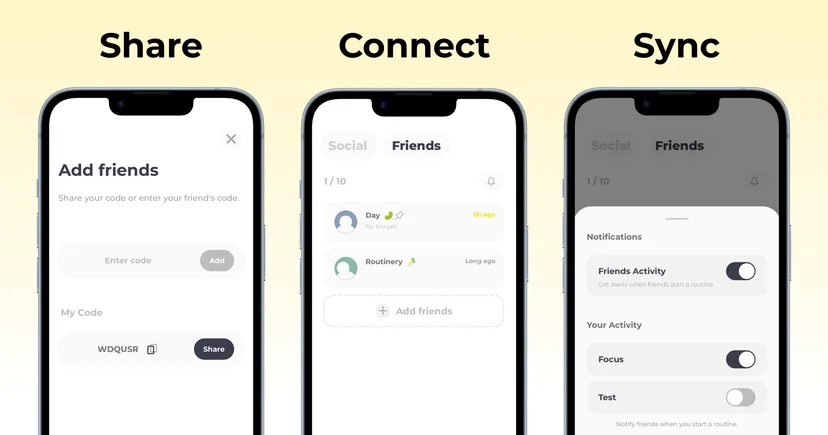
Routinery reflects this idea through a simple feature:
you can add a friend using a code, creating a lightweight social connection within the app.
After connecting:
-
When a friend starts a routine, a notification appears.
-
When you start your own routine, your friend receives one as well.
-
Both individuals stay aware of each other’s progress, even without aligning schedules.
This quiet loop recreates the core behavioral principles—visibility, expectation, and shared rhythm—without requiring constant coordination.
It turns solitary routines into something gently collaborative.
How simple cues support New Year resolutions
Small social cues reduce friction and help transform resolutions into repeatable behaviors. A reminder connected to another person carries more weight than a reminder connected only to one’s own intention.
This is especially powerful during the early weeks of a new habit, when consistency is most fragile.
A Small Relational Cue Can Change the Entire Year
Most New Year resolutions fail not because ambition is misplaced but because the behavior stands alone. A single relational element—a friend, a shared timeline, or even a notification—can shift a habit from fragile intention to stable routine. Behavioral science suggests that resolutions last longer when they are supported, seen, or shared—even lightly.
Doing it with a friend is not an optional enhancement. It is often the structure that makes new habits possible.
Turn this into a daily routine with Routinery.
Step-by-step timers and cues that make routines stick.
Build habits with a friend →