
Contents
Quick Summary: What a Mandalart Chart DoesWhat Is a Mandalart Chart?Why the Mandalart Chart Works (Even If You’re Not “Disciplined”)Shohei Ohtani’s Goal Template: Why It Became So FamousFree Mandalart Chart Template (Printable)How to Fill Out Your Mandalart Chart (Step-by-Step)Common Mandalart Chart Mistakes (And How to Fix Them)Turn Your Mandalart Chart Into Daily Action (Where Most People Get Stuck)How Routinery Helps You Execute Your Mandalart Chart (Without Burnout)Final Thoughts: A Chart Is a Tool. A Routine Is a Practice.FAQ: Mandalart Chart TemplateHave you ever set a goal, felt fired up… and then watched the momentum disappear a week later?
You’re not alone.
Most goals don’t fail because people “lack motivation.”
They fail because the plan stays too big, too vague, and too far away from daily life.
That’s why one goal-setting tool keeps resurfacing online every year:
✅ the Mandalart chart — the grid-style goal map often linked to the Shohei Ohtani goal template from his high school years.
It’s not inspiration.
It’s structure.
A Mandalart chart helps you turn one big goal into:
-
8 supporting sub-goals (your system)
-
64 small action steps (your daily and weekly behaviors)
And that’s what makes it so powerful:
it forces your goal to become something you can actually do.
In this guide, you’ll get:
-
What a Mandalart chart is (and why it works)
-
What people learn from Shohei Ohtani’s Mandala chart
-
A free printable Mandalart chart template (3×3 + 9×9)
-
A step-by-step guide to filling yours out
-
A practical way to turn your chart into habits you’ll stick with
Quick Summary: What a Mandalart Chart Does
A Mandalart chart is a 9×9 grid that turns one goal into 64 action steps.
It works by:
-
placing your main goal in the center
-
surrounding it with 8 key sub-goals
-
expanding each sub-goal into 8 concrete actions
If you’ve ever searched for:
-
“mandalart chart template”
-
“mandala chart template”
-
“Shohei Ohtani goal chart”
-
“Ohtani mandala chart printable”
You’re in the right place.
What Is a Mandalart Chart?
A Mandalart chart (sometimes called a Mandala chart or “mandala goal chart”) is a goal-setting framework built around a grid.
At its core:
-
The center box is your main goal
-
The 8 boxes around it are your supporting sub-goals
-
Each sub-goal expands into its own mini-grid, creating 64 action steps
It forces one essential question:
“If this is my goal… what does it actually require from me?”
Instead of planning in vague outcomes (“get healthier”), you build a roadmap of:
-
habits
-
skills
-
systems
-
environment
-
mindset
-
routines
It’s goal setting that naturally pushes you toward behavior design.
Why the Mandalart Chart Works (Even If You’re Not “Disciplined”)
The Mandalart chart works because it does three things most systems don’t:
1) It reduces overwhelm
Big goals feel heavy because they’re abstract.
Mandalart charts break them into pieces your brain can actually handle.
2) It turns goals into inputs
Most people track outcomes.
Mandalart charts push you to track behaviors.
3) It makes progress visible
You can literally see your goal turning into steps.
That visual clarity makes consistency easier.
A Mandalart chart doesn’t make your goal more inspiring.
It makes your goal more doable.
Shohei Ohtani’s Goal Template: Why It Became So Famous
Shohei Ohtani shows up constantly in searches for “Mandalart chart template” because his chart became symbolic.
Not because a grid “made him successful”—
but because it shows what most people skip:
✅ high achievers don’t rely on vague motivation.
They build systems.
The Shohei Ohtani mandala chart became widely shared because it reflects something rare:
-
clear direction
-
balanced development
-
consistent daily behaviors
Even if you’re not trying to become a pro athlete, the framework is transferable.
What we can learn from the Ohtani goal chart
1) He didn’t focus on only one area
His sub-goals weren’t just about skill.
They included body, mindset, habits, learning, relationships, and lifestyle.
2) His action steps were behaviors, not wishes
Instead of “get better,” the chart forces actions:
practice routines, recovery habits, study methods, consistent training.
3) It was designed to be lived, not admired
Not a pretty notebook page—
a structure meant to shape daily life.
Free Mandalart Chart Template (Printable)
Below are two free Mandalart chart printables you can copy and print right away:
- a full 9×9 Mandalart chart template (the classic format)
Full 9×9 Mandalart Chart (Blank)
This is the full Shohei Ohtani–style format:
it expands each sub-goal into 8 action steps, creating 64 total actions.
How to print cleanly:
Use a monospace font (Courier New) → keep margins narrow → print on US Letter or A4.
✅ How to use it:
-
Place your main goal in the center
-
Surround it with 8 sub-goals
-
Expand each sub-goal into 8 action steps
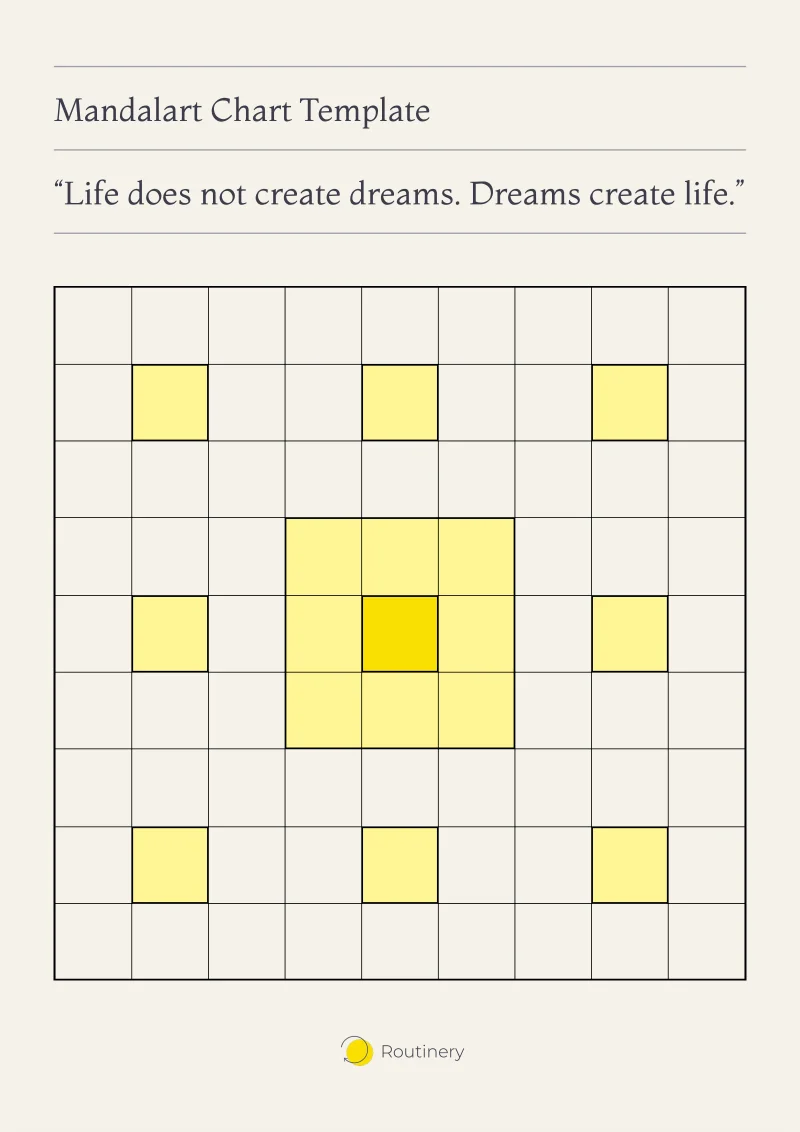
Printable Mandalart chart template for goal setting (9x9 grid)
How to Fill Out Your Mandalart Chart (Step-by-Step)
Step 1) Choose one clear, measurable main goal
A Mandalart chart works best when your goal can be measured.
Good examples:
-
Run a half marathon in 6 months
-
Save $5,000 this year
-
Publish 24 YouTube videos
-
Reach conversational Spanish in 90 days
Avoid vague goals like “be better.”
Step 2) Create 8 sub-goals that support the main goal
Think of sub-goals as categories that feed the goal.
Common sub-goal categories:
-
Skill / Practice
-
Body / Health
-
Mindset
-
Knowledge / Learning
-
Environment
-
Habits / Routine
-
Support / Relationships
-
Recovery / Rest
Step 3) Turn each sub-goal into 8 action steps
This is where the chart becomes useful.
Your action steps should be:
-
small
-
repeatable
-
doable in 5–20 minutes
-
behaviors, not outcomes
✅ Rule of thumb: If it can’t be done in 15 minutes, it’s probably too big.
Step 4) Highlight daily / weekly actions
Circle the actions you can do daily or weekly.
That’s how the chart becomes a life structure, not just a plan.
Step 5) Pick your top 3 actions for the next 7 days
You don’t need to execute 64 actions this week.
You need to start with three.
Common Mandalart Chart Mistakes (And How to Fix Them)
Mistake 1: Filling it with outcomes
Rewrite outcomes into behaviors.
Mistake 2: All sub-goals are the same category
Add support categories like recovery, environment, and mindset.
Mistake 3: Trying to fill every box perfectly
You can start with 50% clarity. The chart evolves.
Mistake 4: Stopping at planning
A chart only works when it becomes something you do.
Turn Your Mandalart Chart Into Daily Action (Where Most People Get Stuck)
Most people love planning.
But planning isn’t execution.
A Mandalart chart gives you clarity—
but clarity won’t automatically create consistency.
To follow through, you need a system that helps you:
-
focus on today’s actions
-
reduce decision fatigue
-
stay flexible when real life changes
That’s why a tool like Routinery becomes the missing link.
How Routinery Helps You Execute Your Mandalart Chart (Without Burnout)
Timer-based focus: One action at a time
Instead of staring at a big chart, select 1–3 actions and run them as a guided sequence.
You don’t think about the whole plan.
You do the next step.
Flexible editing: Adjust without breaking consistency
Some weeks are busy. Some weeks are easy.
Routinery lets you shorten, swap, or reorder actions without guilt.
That flexibility is what makes long-term goals sustainable.
Final Thoughts: A Chart Is a Tool. A Routine Is a Practice.
The Mandalart chart keeps coming back because it turns goals into clarity—
and clarity reduces friction.
Shohei Ohtani’s chart became viral because people realized something:
Greatness is rarely about motivation.
It’s about structure.
So print your template.
Fill it out imperfectly.
Pick three actions for this week.
And if you want to turn your chart into habits you can actually follow—especially on days when motivation disappears—Routinery helps you run your actions step by step and adjust anytime.
FAQ: Mandalart Chart Template
What is a Mandalart chart?
A Mandalart chart is a 9×9 goal-setting grid that breaks one main goal into 8 sub-goals and 64 action steps. It helps turn vague goals into daily behaviors you can actually repeat.
Is a Mandalart chart the same as a Mandala chart?
Yes. A Mandalart chart is often called a Mandala chart (or “Mandala goal chart”), and both terms refer to the same 9×9 goal-mapping framework.
Why is Shohei Ohtani’s Mandalart chart famous?
Shohei Ohtani’s goal chart became viral because it shows how high achievers build systems—not just motivation. His chart focused on balanced sub-goals and concrete action steps, making long-term progress more realistic.
How do I fill out a Mandalart chart template?
Start by writing one measurable main goal in the center. Then add 8 sub-goals around it, and expand each sub-goal into 8 small actions you can do in 5–20 minutes.
What should I write in the 64 action step boxes?
Write behaviors, not outcomes. Instead of “lose weight,” write “walk 20 minutes daily.” The best action steps are small, repeatable, and realistic enough to do on busy days.
Can I use a Mandalart chart for habits instead of big goals?
Absolutely. Mandalart charts work well for habit building because they force you to define daily inputs. You can use them for fitness, studying, creative work, language learning, or any routine-based goal.
Is this Mandalart chart template printable?
Yes. The templates in this guide are designed to be printable on US Letter or A4. You can also offer a downloadable PDF version for cleaner printing.
Turn this into a daily routine with Routinery.
Step-by-step timers and cues that make routines stick.
Build Your Daily Routine in Routinery →