
Contents
Treating ADHD in daily life means supporting executive function, not chasing focusA practical structure checklist for ADHD daily managementWhy structure works when motivation doesn’tTurn this checklist into something you can actually use every dayThe goal is not perfect days—it’s recoverable onesIf you’ve searched how to treat ADHD, you’ve probably seen the same three buckets: medication, therapy, and coaching. Those can be genuinely helpful, and for many people they’re essential. But there’s a quieter part that often gets skipped in the conversation: what happens in the hours between appointments, reminders, and good intentions.
That’s where daily life usually falls apart. Not because someone “doesn’t care enough,” but because ADHD makes certain moments disproportionately expensive: starting, switching, stopping, and restarting. Treating ADHD in daily life means building support for those moments—so the day doesn’t depend on motivation staying strong.
This article offers a practical checklist you can return to. Not to judge yourself. Not to “fix” your brain. Just to notice where your day needs more structure, and what kind of structure actually helps.
Treating ADHD in daily life means supporting executive function, not chasing focus
A lot of ADHD advice is framed like this: “Find the perfect productivity system, then stick to it.” That’s backwards. For many people with ADHD, the problem isn’t a lack of plans. It’s the invisible effort required to do the simplest transitions:
-
moving from thinking to starting
-
moving from one task to the next
-
returning after being interrupted
-
stopping before burnout
-
resetting after a day derails
So when people ask how to treat ADHD, it helps to widen the definition:
-
Clinical treatment can reduce symptoms and improve functioning.
-
Daily-life treatment support helps the day stay navigable, even when symptoms show up.
This is not “either/or.” It’s “and.” The day needs a structure that doesn’t collapse the moment attention slips.
A practical structure checklist for ADHD daily management
Read this like a map, not a test. You don’t need to “pass” every item. The value comes from spotting patterns—especially the ones that repeat on your hardest days.
1) Is the first 5 minutes of the day decided in advance?
ADHD mornings often fail before they start. Not from laziness, but from decision overload. The brain meets uncertainty and tries to avoid it.
If this is shaky, try:
Choose one non-negotiable “first action.” Make it small. Examples: open curtains, drink water, wash face, sit at desk, put on shoes. The goal is movement, not achievement.
2) Do tasks have a clear “starting line,” not just an outcome?
“Do taxes” or “clean the house” are outcomes. ADHD needs starting lines.
If this is shaky, try:
Rewrite tasks as the first 2 minutes: “Open the tax portal,” “Put a trash bag in,” “Clear the top of the desk.” Starting lines reduce resistance.
3) Do you regularly hit “What should I do next?” moments?
That question feels small. It isn’t. It’s a fork in the road where ADHD often leads to scrolling, snacking, wandering, or switching tabs.
If this is shaky, try:
Prepare a short “next list” of 3 options—only 3. Not a master to-do list. Just the next few moves for today.
4) Is there a built-in way to return after interruption?
Interruptions aren’t rare. They’re the default. Without a return mechanism, ADHD days become a series of unfinished restarts.
If this is shaky, try:
Add a “return step” after any interruption: a 30-second reset that tells your brain, “We’re back.” Examples: re-open the document, reread the last paragraph, rewrite the next sentence, set a 10-minute timer.
5) Do transitions between tasks feel harder than the tasks themselves?
If yes, that’s not a personal flaw. Transition cost is real.
If this is shaky, try:
Insert a micro-bridge between tasks: stand up, refill water, clear one item, breathe for 30 seconds, then start. Treat transitions as part of the plan, not a failure of willpower.
6) Do you rely on “remembering” instead of external cues?
ADHD and memory are not reliable teammates. If the system depends on remembering, it will break under stress.
If this is shaky, try:
Move key steps out of your head and into cues: a checklist, a timer, an alarm, a visual note, a routine sequence. External cues reduce mental load.
7) Is your day structured for energy, or only for time?
Many plans assume stable energy. ADHD often comes with variable energy and attention. A schedule can look perfect and still fail if it fights your peaks and dips.
If this is shaky, try:
Identify one high-energy window and one low-energy window. Put “start-heavy” tasks in the high-energy slot and “maintenance tasks” in the low-energy slot.
8) Do you have a “minimum day” plan for rough days?
Without a minimum plan, a hard moment can turn into an all-day collapse. Then guilt kicks in, which makes it harder to restart.
If this is shaky, try:
Define a minimum day in 3 items. Example: take meds (if applicable), eat something, do one 5-minute reset. Minimum days keep the identity intact.
9) Do you have a reset point when the day derails?
A lot of ADHD suffering comes from this belief: “If I fell off, the day is ruined.” That turns one slip into a spiral.
If this is shaky, try:
Pick a reset ritual and tie it to a time: after lunch, at 3pm, after a meeting, after school pickup. Resets are planned, not earned.
10) Are you tracking effort—or only results?
If you only measure results, ADHD will always look like failure. Effort is real work: starting, returning, choosing, resisting avoidance.
If this is shaky, try:
Track completions and returns. “Returned to task 3 times” can be more meaningful than “finished everything.”
Why structure works when motivation doesn’t
Motivation is a mood. ADHD support has to be a system.
Structure doesn’t mean rigid rules. It means reducing the number of high-friction decisions in a day. Every time a day relies on “figuring it out in the moment,” ADHD pays interest—mentally, emotionally, and physically.
A supportive structure does a few specific things:
-
It makes the next step obvious.
-
It makes returning easy.
-
It makes starting smaller.
-
It makes failure recoverable.
That last one matters more than most people expect. A system that can’t handle derailment isn’t a system—it’s a setup for shame.
Turn this checklist into something you can actually use every day
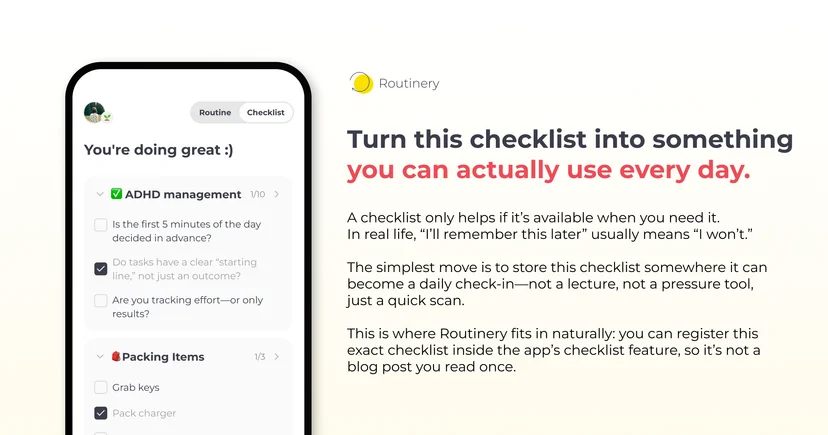
A checklist only helps if it’s available when you need it. In real life, “I’ll remember this later” usually means “I won’t.” The simplest move is to store this checklist somewhere it can become a daily check-in—not a lecture, not a pressure tool, just a quick scan.
This is where Routinery fits in naturally: you can register this exact checklist inside the app’s checklist feature, so it’s not a blog post you read once. It becomes a reusable support tool you can open anytime—especially on scattered days.
The point isn’t to check every box. The point is to notice which box matters today.
Some days you’ll realize: “I need a clearer starting line.”
Other days: “I need a reset point.”
And sometimes: “I need a minimum day plan, and that’s enough.”
That’s daily-life treatment support in practice: less self-blame, more structure you can return to.
The goal is not perfect days—it’s recoverable ones
If you came here searching how to treat ADHD, it’s worth holding one idea close: treatment isn’t only what helps when things go well. It’s what helps you come back when they don’t.
Daily structure won’t replace clinical care, and it shouldn’t try to. But it can make your day feel less like a constant improvisation—and more like a path with handrails.
Start with one section of the checklist. Save it. Revisit it. Let “support” be the standard, not “willpower.”
Disclaimer
This content is for informational and self-regulation support purposes only and is not intended to diagnose, treat, or replace professional mental health care.
Turn this into a daily routine with Routinery.
Step-by-step timers and cues that make routines stick.
Turn This Checklist Into a Daily Routine with Routinery →