
Contents
Why New Year Pressure Feels So HeavyWhen a January Reset Becomes CounterproductiveNot All Change Needs to Start in JanuaryRethinking What Routines Are ForPlanning Without Turning Plans Into PressureHow Routinery Fits Into a Slower JanuaryLet January Be a Transition, Not a TestJanuary arrives with expectations already attached. Reset your life. Set new goals. Become a better version of yourself.
For many people, the pressure starts before the year even begins. New year pressure builds quietly, through conversations, social feeds, workplace chatter, and endless reminders that January is supposed to mean change.
But January does not ask for proof.
And it does not require transformation.
Why New Year Pressure Feels So Heavy
The start of a new year is often treated like a performance checkpoint. Goals are expected. Progress is assumed. Motivation is taken for granted.
This pressure rarely comes from a single source. It accumulates from everywhere at once.
Productivity culture frames January as a reset button.
Social media amplifies stories of radical change.
Workplaces talk about fresh starts, new metrics, new momentum.
Even without explicit demands, the message is clear:
If nothing changes, something is wrong.
For people already tired, this expectation lands as weight. The year has not even begun, yet the sense of falling behind is already present.
When a January Reset Becomes Counterproductive
A January reset is often described as empowering. In practice, it can quietly erase continuity. Resetting implies starting over. It suggests that what came before should be discarded, rather than carried forward.
This creates a familiar cycle:
-
ambitious planning
-
forced execution
-
early friction
-
abandonment
-
self-judgment
The issue is not a lack of discipline. It is a mismatch between expectation and readiness. When resets are treated as mandatory, routines stop feeling supportive. They become tests.
Not All Change Needs to Start in January
Change does not gain meaning from a calendar date. A new year goal is not automatically healthier because it begins on January 1st.
Readiness is uneven.
Some people begin the year energized.
Others begin it depleted.
Neither state requires correction.
Slowing down is often mislabeled as avoidance. In reality, it can be an accurate response to limited capacity. Choosing not to rush is not a failure to improve. It is a form of alignment.
Rethinking What Routines Are For
Routines are often framed as tools for discipline. Something to follow. Something to maintain. But routines can also function as containers. They hold intentions without demanding immediate action.
This is where the idea of a draft routine becomes useful.
A draft routine exists without urgency.
Tasks are written down, but notifications remain off.
There is no expectation to start, no pressure to perform.
The routine is allowed to wait.
Instead of asking, “Why isn’t this being done?”
the question becomes, “When will this feel supportive?”
Planning Without Turning Plans Into Pressure
For people who still want structure, planning does not have to mean commitment.
A draft routine might look like this:
-
a short list of actions
-
a clear order
-
no schedule attached
-
no reminders enabled
The value lies in clarity, not execution. This approach separates thinking from doing. It allows ideas to exist without becoming obligations. And for those who do not want to plan at all, that choice is equally valid.
January does not require preparation.
It permits uncertainty.
How Routinery Fits Into a Slower January
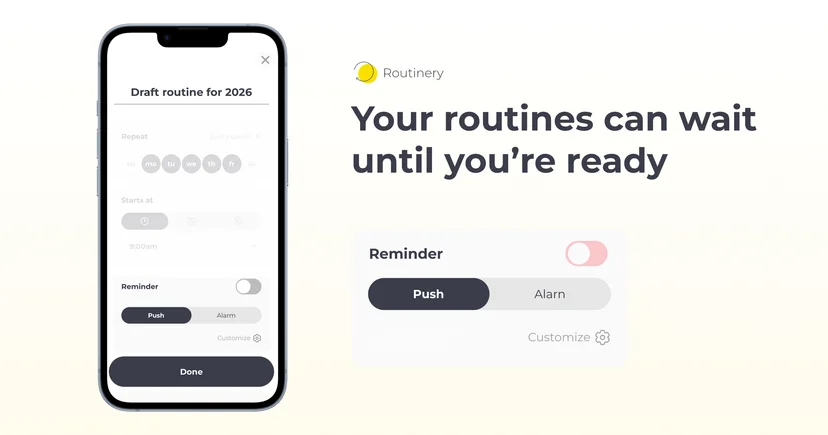
A softer January still needs structure. Just not the kind that demands immediate execution. This is where many routine tools fall short. They assume that planning means starting, and starting means committing.
Routinery is designed differently. It allows routines to exist before they are active.
Routines That Don’t Demand Action
In Routinery, routines do not have to be turned on the moment they are created. Tasks can be written down, sequenced, and saved—
while notifications remain off.
This makes it possible to treat routines as drafts.
-
Planned, but inactive
-
Visible, but quiet
-
Ready, without being urgent
Instead of pushing users to begin, the structure allows waiting.
Turning Off Pressure Without Losing Structure
New year pressure often comes from the fear that plans will disappear if they are not acted on immediately. Routinery removes that fear.
Draft routines stay intact without reminders. Nothing breaks if a routine is not started. Nothing is counted as failure.
This shifts the role of routines:
-
from performance tools
-
to supportive frameworks
January no longer becomes a deadline. It becomes a transition.
When Readiness Returns, Structure Is Already There
A slower start does not mean starting from zero later.
When energy returns, routines can be activated without rebuilding everything from scratch. The structure already exists. The decisions have already been reduced. This continuity matters.
It allows people to move at their own pace without turning hesitation into self-judgment.
A Tool That Respects Timing
Routinery is not built to enforce discipline at all costs. It is built to support follow-through when timing is right.
For a January that feels heavy, this distinction matters. Because sometimes the most helpful routine is one that knows how to wait.
Let January Be a Transition, Not a Test
January does not need to be conquered. It does not need to be optimized. It can simply be entered.
Without a reset.
Without a declaration.
Without a better version of oneself attached.
Routines are meant to reduce friction, not create it. When pressure is removed, consistency becomes more sustainable. The new year does not demand transformation.
It allows continuity.
Turn this into a daily routine with Routinery.
Step-by-step timers and cues that make routines stick.
Build your own draft routine with Routinery →