
Contents
Quick Answer: How Are Overthinking and Anxiety Connected?When Worry Turns Into OverthinkingEveryday Examples of Overthinking and AnxietyHow Anxiety Amplifies Repetitive ThinkingThe Overthinking–Anxiety LoopWhy the Brain Keeps Searching for AnswersHow to Break the Overthinking–Anxiety CycleStructured Activity and Cognitive ReliefUnderstanding the Loop Can Be ReassuringFAQQuick Answer: How Are Overthinking and Anxiety Connected?
Overthinking and anxiety often reinforce each other in a repeating cycle. When the mind repeatedly analyzes uncertain situations, it increases perceived risk. That perceived risk raises anxiety levels. Higher anxiety then triggers more rumination, continuing the loop.
Breaking this cycle usually requires interrupting repetitive thinking with action, attention shifts, or structured routines.
When Worry Turns Into Overthinking
Worry is a normal mental process.
Sometimes it helps us prepare for challenges or avoid mistakes.
But worry can slowly turn into something different.
Instead of thinking through a situation once and moving forward, the mind keeps returning to the same questions.
You replay the same scenario repeatedly.
You imagine different outcomes.
You try to predict what might go wrong.
At first, this may feel like problem-solving.
But over time the thinking stops helping and starts creating more tension.
This is when worry becomes overthinking.
Everyday Examples of Overthinking and Anxiety
The connection between overthinking and anxiety often appears in everyday situations.
For example:
-
Replaying a conversation repeatedly and wondering if you said the wrong thing
-
Rereading an email many times before sending it
-
Imagining worst-case scenarios about work decisions
-
Mentally revisiting the same future worry late at night
In each situation, the mind is trying to reduce uncertainty.
But instead of creating clarity, the thinking increases anxiety.
How Anxiety Amplifies Repetitive Thinking
Anxiety changes the way the brain processes information.
When anxiety rises, the brain becomes more alert to potential threats. Psychologists often describe this as threat sensitivity.
Because the brain is trying to detect possible problems, uncertain situations receive more attention.
This can trigger repetitive questions such as:
-
What if something goes wrong?
-
What if I overlooked something important?
-
What if I made the wrong decision?
Each question encourages more analysis.
More analysis increases uncertainty.
And increased uncertainty strengthens anxiety.
The Overthinking–Anxiety Loop
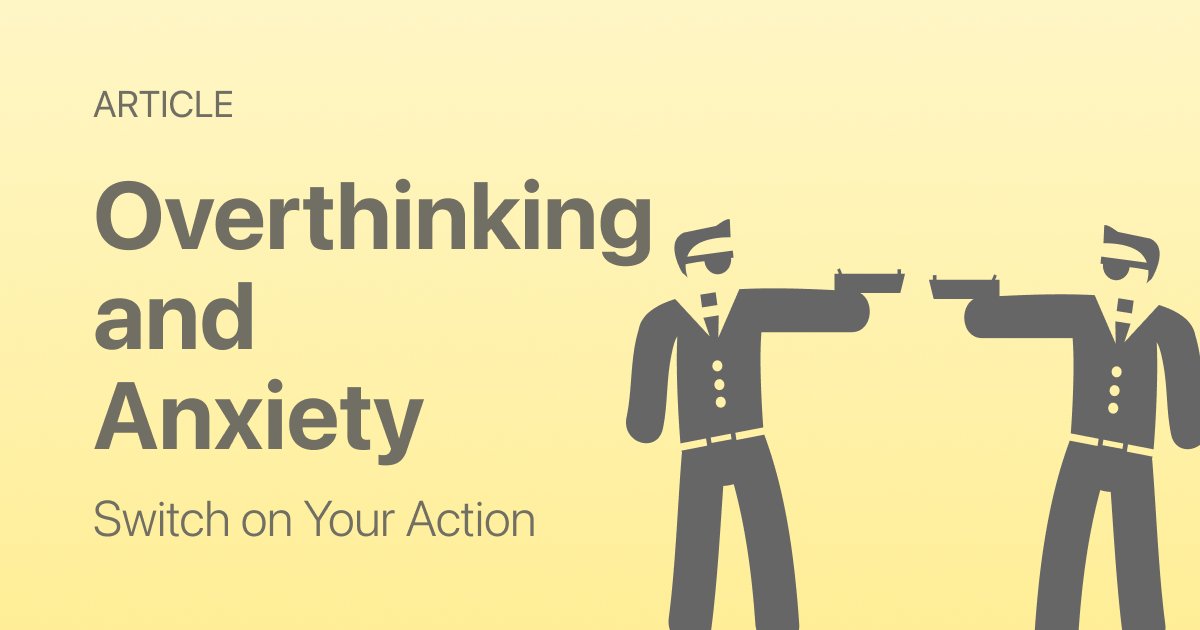
Psychologists often describe the relationship between overthinking and anxiety as a feedback loop.
The cycle usually looks like this:
Uncertainty
↓
Overthinking
↓
Increased Anxiety
↓
Threat Scanning
↓
More Overthinking
Because the brain interprets uncertainty as risk, it keeps analyzing the same problem in search of safety.
Unfortunately, this constant analysis rarely produces the certainty the brain wants.
Instead, the loop continues.
Why the Brain Keeps Searching for Answers
The brain prefers certainty.
When something feels unresolved, it naturally tries to generate explanations or predictions.
This process is helpful when solving practical problems.
However, many sources of anxiety — such as social situations or future outcomes — cannot be fully predicted.
When the brain tries to eliminate uncertainty through thinking alone, the process can become endless.
More thinking produces more possible outcomes.
More outcomes create more worry.
How to Break the Overthinking–Anxiety Cycle
One of the most effective ways to weaken the cycle is to shift from thinking to action.
Action changes how the brain receives information.
Instead of imagining possibilities, the mind begins responding to real events.
Several strategies can help interrupt the loop:
1. Start a small physical action
Even a short walk or simple task can redirect attention away from rumination.
Breaking the Cycle Gradually
The overthinking–anxiety cycle rarely disappears instantly.
Instead, change usually begins with small shifts in behavior:
-
taking a short walk
-
starting a simple task
-
following a brief routine
These actions may seem minor, but they change how the brain processes information.
Instead of analyzing imagined possibilities, the mind begins responding to real experiences.
Over time, this shift can reduce rumination and anxiety.
2. Limit analysis time
Setting a time boundary for thinking about a problem can prevent endless mental loops.
3. Write the concern down
Externalizing worries often reduces the need to keep repeating them mentally.
4. Shift attention to structured tasks
Focused activities reduce the mental space available for repetitive thinking.
Structured Activity and Cognitive Relief
Unstructured time often allows rumination to grow.
When the mind has nothing specific to focus on, it may return to unresolved worries.
Structured activities reduce this mental space.
Even simple sequences of tasks can redirect attention and interrupt repetitive thinking.
Some people create personal routines for this purpose.
Others use structured routine systems such as Routinery, which guide small timed activities in sequence. By reducing decision-making and providing clear next steps, these routines help shift attention away from repetitive thoughts.
Understanding the Loop Can Be Reassuring
Learning how overthinking and anxiety reinforce each other can be helpful.
It shows that the experience is not a personal weakness.
It is a common cognitive pattern.
Once you recognize the loop, it becomes easier to interrupt it.
Small actions, structured routines, and shifts in attention can gradually weaken the cycle of repetitive thinking and anxiety.
FAQ
Can overthinking cause anxiety?
Yes. Overthinking increases perceived uncertainty and risk, which can activate the body's stress response and raise anxiety levels.
Does anxiety make overthinking worse?
Yes. Anxiety increases sensitivity to potential threats, which often leads to more rumination and repetitive analysis.
How do I stop the overthinking and anxiety cycle?
Breaking the cycle usually involves shifting attention from thinking to action. Small tasks, physical movement, or structured routines can help interrupt repetitive thoughts.
Is rumination a symptom of anxiety?
Rumination often occurs alongside anxiety. Repeatedly focusing on worries can intensify anxious feelings and make it harder to move forward.
Turn this into a daily routine with Routinery.
Step-by-step timers and cues that make routines stick.
Download Routinery — Try It Free for 7 Days →