
Contents
Why Small Actions Beat Perfect PlansWhere New Year Resolutions Usually BreakDesigning a Routine That Doesn’t BreakA Simpler Way to Approach New Year GoalsEvery January, new year resolutions return with familiar energy. People set new year goals with care, outline routines, download planners, and promise themselves that this year will be different. The intention feels genuine. The motivation feels real. And yet, for many, the same question quietly appears a few weeks later: why does this keep happening?
Search queries spike every January around phrases like “why new year resolutions fail” or “can’t stick to new year goals.” The problem isn’t a lack of desire to change. It’s that the way change is framed at the beginning of the year often works against action instead of supporting it.
When goals are treated as something that must be done properly, completely, and consistently from day one, starting begins to feel heavier than it needs to be. A workout doesn’t count unless it’s long enough. A routine doesn’t count unless it’s followed exactly. A habit doesn’t count unless it matches the original plan. Small actions lose their value, even though they are the only actions that reliably happen when motivation fluctuates.
As a result, plans improve while behavior stays still. The resolution feels polished, but nothing moves. This is how perfect new year resolutions delay execution without looking like procrastination.
Why Small Actions Beat Perfect Plans
Behavior doesn’t need a perfect plan to begin. It needs an entry point that feels accessible in real life. Small actions work because they lower the cost of starting. They don’t ask whether something is impressive, optimized, or meaningful enough. They only ask whether it happens.
Five minutes of movement is easier to begin than a full workout. Opening a document is easier than finishing a project. One clear task is easier than a complete system. Small actions remove the question of how well something should be done and replace it with a simpler one: can this start right now?
This matters because motivation is unreliable, especially during periods of transition like the start of a new year. Energy levels fluctuate. Schedules shift. Expectations collide with reality. When progress depends on ideal conditions, action waits. When progress depends on small, repeatable steps, action begins despite imperfection.
This is why small action consistently outperforms perfect planning when it comes to new year goals. Not because ambition is wrong, but because scale determines whether action actually starts. The smaller the action, the easier it is to enter. And once movement exists, consistency becomes possible.
Small actions create momentum not by being inspiring, but by being doable.
Where New Year Resolutions Usually Break
Most new year resolutions don’t fail because people stop caring. They break because the plan assumes life will move in a straight line. One missed day turns into hesitation. One disrupted routine turns into doubt. Restarting begins to feel harder than continuing, even though logically it shouldn’t be.
This is the moment many people recognize: I’ve already fallen off. I’ll start again later.
Later often never comes.
The issue here is not discipline or commitment. It’s structure. A routine that only works when everything goes according to plan is fragile by design. Real life introduces interruptions, low-energy days, and unexpected changes. When routines don’t account for that reality, even small disruptions feel like failures.
This is where flexibility becomes essential. Not as a motivational concept, but as a structural requirement. A routine needs to allow for missed steps without collapsing. Skipping one action should not invalidate the rest. Pausing briefly should not require rebuilding everything from scratch. Changing the order of tasks should not feel like breaking the system.
Flexibility is what allows small actions to survive imperfect days. Without it, even the smallest habit eventually breaks under normal life conditions.
Designing a Routine That Doesn’t Break
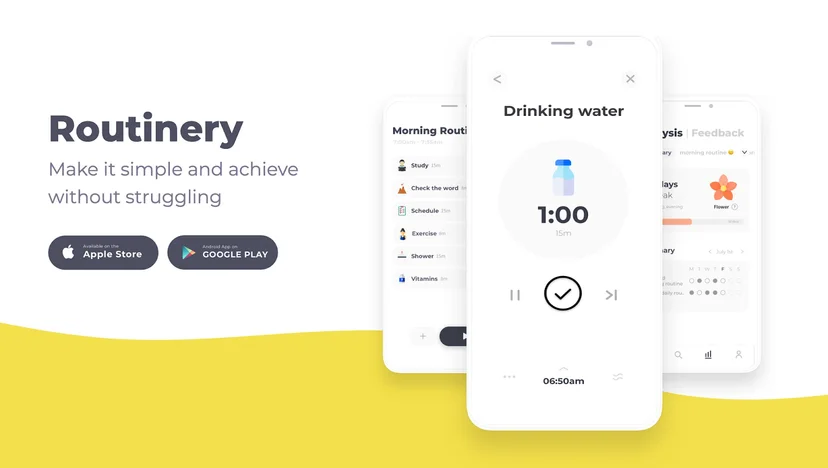
Routinery is designed around routines as sequences of small actions
Small actions only matter if they can be repeated. For repetition to happen, execution needs support rather than pressure. A routine that lasts is one that can bend without breaking.
This is where tools like Routinery fit naturally into the picture. Routinery is designed around routines as sequences of small actions, rather than rigid rules that must be followed exactly. Each step can remain short. Each routine can adjust when the day changes. Skipping or rearranging a task doesn’t erase progress or turn the day into a failure.
Instead of treating routines as something to execute perfectly, the structure prioritizes return. Coming back after a pause is treated as part of the process, not a mistake. This allows small actions to stay alive long enough to compound into meaningful change.
The goal isn’t flawless execution. It’s continuity. And continuity depends less on motivation than on whether the system can handle real life without collapsing.
A Simpler Way to Approach New Year Goals
New year resolutions don’t fail because they aim too high. They fail because they demand too much certainty before action begins. When everything needs to be aligned before starting, starting gets postponed.
A single small action today does more than a perfect plan waiting for the right moment. Progress doesn’t need to look impressive to be effective. It needs to exist.
Start smaller than you think you should. Let routines adjust as life does. Allow progress to look incomplete. That’s how habits survive beyond January and how new year goals turn into something that actually lasts.
Turn this into a daily routine with Routinery.
Step-by-step timers and cues that make routines stick.
Build a routine that doesn’t break with Routinery →