
Contents
When Caring Starts to Cost More Than It GivesDoing Less Is Not Neglect — It’s Selective CareA Doing-Less Self-Care RoutineRethinking What Self-Care Actually RequiresSelf-care is everywhere. But burnout hasn’t gone anywhere. As self-care content became mainstream, something else started to rise alongside it.
A quieter, blunter reaction often summarized as:
“I don’t care.”
Not as a belief system. As a signal. This isn’t about apathy.
It’s about overload.
When Caring Starts to Cost More Than It Gives
For years, self-care has been framed as an addition.
More awareness.
More intention.
More routines to maintain.
What often goes unexamined is the cost of that caring. Every act of self-care still requires decisions:
-
What should I do?
-
Am I doing it right?
-
Is this enough?
For people already depleted, those decisions are not neutral. They add weight. In that context, saying “I don’t care” doesn’t mean giving up.
It means withholding attention from things that no longer deserve it.
Doing Less Is Not Neglect — It’s Selective Care
Doing less is often mistaken for avoidance. In practice, it is deliberate.
It means:
-
Caring about fewer things
-
Reducing emotional negotiation
-
Lowering the number of moments that require self-evaluation
This reframes self-care away from self-improvement and toward load management. The goal is not to feel better right away. It is to stop making things heavier.
A Doing-Less Self-Care Routine
This routine is designed for moments when:
-
motivation is low
-
emotions feel crowded
-
even “self-care” feels like effort
Total time: 4–5 minutes
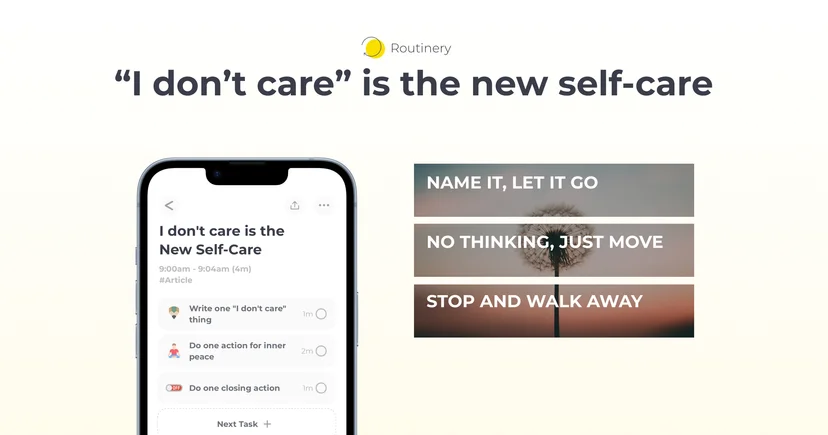
1. Write One “I Don’t Care” Thing (1 minute)
Task
On a piece of paper, write one thing you don’t care about right now.
Rules
-
One sentence only
-
No explanation
-
No problem-solving
Examples:
-
“I don’t care about replying today.”
-
“I don’t care if this isn’t perfect.”
-
“I don’t care about finishing everything.”
Once written, fold the paper or turn it face down.
The goal is not insight.
It is externalization.
2. Do One Action for Inner Peace (2 minutes)
Task
Choose one calming physical action and do it for two minutes.
Options:
-
Drink a glass of water slowly
-
Wash your hands with warm water
-
Sit still and breathe naturally
-
Stretch your shoulders and neck once
Rules
-
No phone
-
No reflection
-
No checking how you feel
This step does not aim to improve mood.
It creates a brief, neutral pause.
3. Do One Closing Action (1 minute)
Task
Do one small action that signals the routine is over.
Options:
-
Put the paper in a drawer
-
Place it under a book
-
Turn it over and leave it on the desk
-
Throw it away
Rules
-
Choose one action
-
Don’t reread what you wrote
-
Don’t add meaning
The routine ends without resolution.
That is intentional.
Add this to your routine on Routinery →
Why This Counts as Self-Care
This routine does not promise clarity or relief. It offers something simpler.
By writing one sentence, the mind lets go of holding it.
By choosing one physical action, the body settles without interpretation.
By closing the routine without fixing anything, effort stays contained.
Nothing is solved. And nothing needs to be.
Rethinking What Self-Care Actually Requires
Self-care has long been framed as an act of addition. More awareness. More effort. More intention. But burnout changes the equation.
When energy is limited, the most supportive action is often not doing more, but reducing what asks something from you.
The popularity of phrases like “I don’t care” reflects that shift. Not as a philosophy of indifference, but as a boundary against overload.
Doing less, in this context, is not neglect. It is a deliberate refusal to keep carrying what no longer helps.
Real self-care does not demand emotional performance. It does not require insight, motivation, or progress. Sometimes, it simply creates a moment where nothing needs to be fixed.
And for many people, that is the most realistic reset available.
Turn this into a daily routine with Routinery.
Step-by-step timers and cues that make routines stick.
Try a gentler self-care routine on Routinery →