
Contents
When Reflection Turns Into Self-CriticismClosing the Year Is Not the Same as Evaluating ItA Lighter Way to Do a Year-End Reset with RoutineryStarting 2026 Without Overhauling Your LifeDecember has a strange pressure to it. Everywhere you look, people are sharing their year-end recap, their biggest wins, their lessons learned, their "new me" plans.
And even if you don't want to compare, it sneaks in anyway:
- 'Did I do enough this year?'
- 'Should I have been better, faster, more consistent?'
If reflection feels heavy right now, that's not a personal failure. It's a very human response to unrealistic expectations.
Here's a quieter truth we don't hear often enough: You don't need to fix your life to close the year well.
When Reflection Turns Into Self-Criticism
Reflection is supposed to help us reset. But at the end of the year, it often does the opposite. Instead of clarity, it brings a list of unfinished plans. Instead of insight, it becomes a subtle form of self-judgment.
You look back and see:
- habits you couldn't maintain
- goals you set but didn't reach
- versions of yourself you thought you'd become by now
So reflection stops being reflective. It starts feeling like a performance review you didn't ask for. If you're tired of that cycle, you're not avoiding growth. You're protecting your energy.
Closing the Year Is Not the Same as Evaluating It
Here's a small but important shift:
Closing the year doesn't require conclusions. It doesn't require lessons. It doesn't require a polished recap.
Sometimes, closing the year is simply acknowledging:
💡 Note "This year happened. And I'm still here."
That alone is enough to create space for something new. You don't owe December a transformation story.
A Lighter Way to Do a Year-End Reset with Routinery
Instead of writing a long year-end recap, try closing the year with a short, structured routine.
Not a reflection session. Not a goal-setting workshop. Just a sequence you can move through once. Slowly. Without fixing anything. No pressure to finish it perfectly.
Task 1. Name One Thing You're Done Carrying
(2 minutes)
Open a note. Or grab a piece of paper. Answer just one question:
What am I allowed to leave unfinished this year?
It could be:
- a goal you never came back to
- a habit that felt forced
- a version of yourself you were chasing
Write one sentence. No explanation. No fixing. When time is up, stop.
Task 2. Notice What Quietly Worked
(2 minutes)
This is not about achievements. Look for something small that didn't drain you:
- a routine you kept without thinking
- a decision that made life slightly easier
- a boundary you didn't break
Write it down as a fact, not a compliment. "This worked." That's enough.
Task 3. Choose a Direction, Not a Goal
(1 minute)
Skip resolutions. Instead, pick one direction for January.
Examples:
- fewer decisions in the morning
- more structure at night
- starting slower than last year
You're not committing. You're just pointing your attention somewhere.
Task 4. Close the Loop
(1 minute)
Do one physical action to signal closure:
- close the notebook
- tidy one small surface
- drink a glass of water
Let your body feel the ending, not just your thoughts. Then you're done.
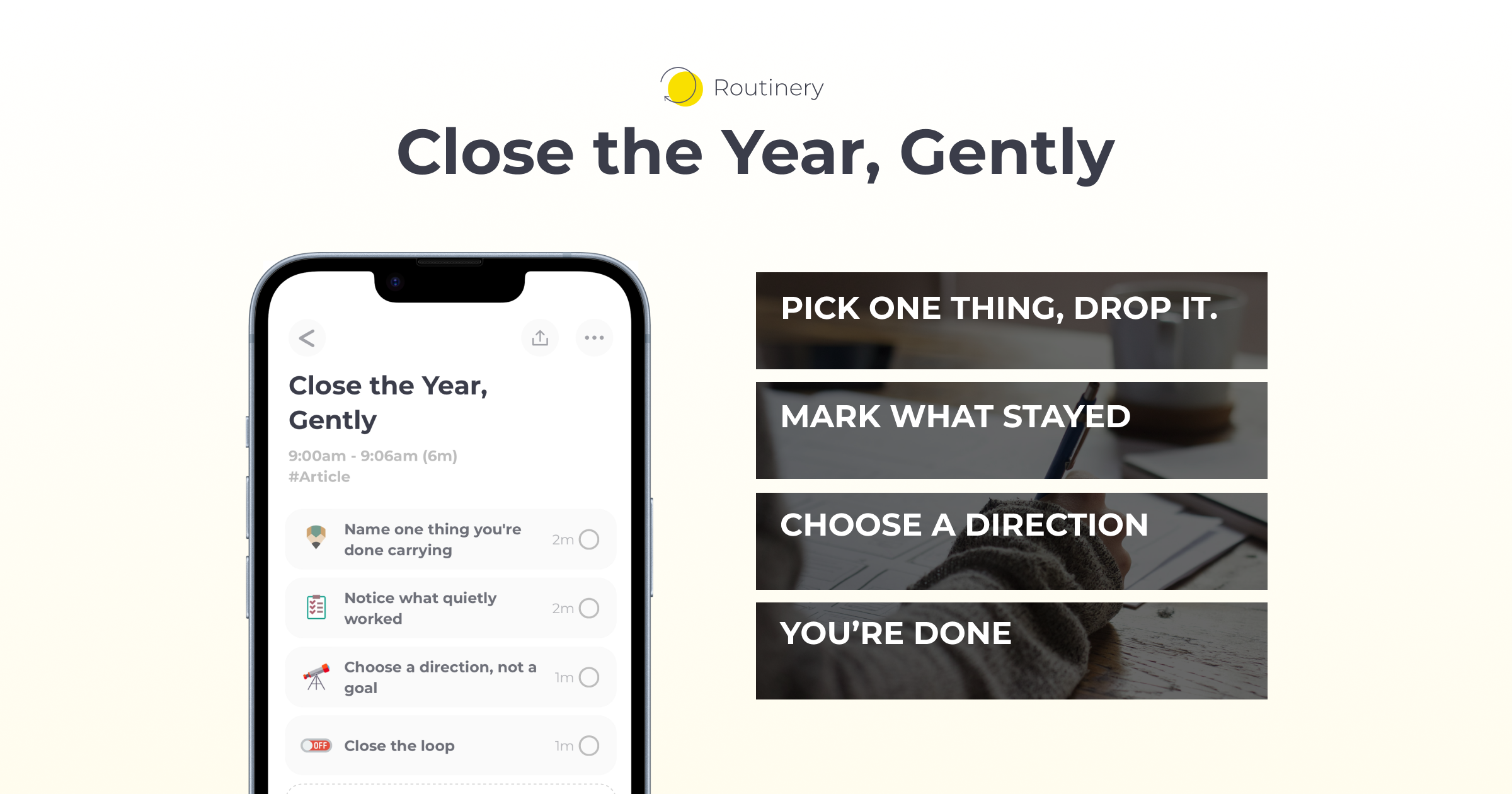
This is what a year-end reset can look like. No fixing. No evaluation. No "new me" pressure.
You Don't Need a New Me — You Need a Softer Start. Just a sequence that helps you close one chapter and leave the next one slightly easier to enter. And if you want, this same structure can quietly become your first routine of the year.
Not a transformation. Just a starting point.
Starting 2026 Without Overhauling Your Life
At Routinery, we don't think routines are about becoming perfect. They're about reducing friction. About letting your days flow without constant decision-making.
A simple morning sequence. A short reset routine after work. A gentle way to begin the year without fixing everything first.
You can treat it as an experiment. Something you try, not something you commit your identity to. Sometimes, that's enough to change how a year feels.
Turn this into a daily routine with Routinery.
Step-by-step timers and cues that make routines stick.
Start a lighter New Year with Routinery →