

💡
editor’s note
Have you ever noticed how, the moment you lie down at night, your thoughts suddenly become louder? The lights go out, your eyes close—and memories you would rather forget quietly resurface. An embarrassing mistake from years ago. A careless remark you barely remember making. Just as sleep feels within reach, your mind pulls you back awake.
Many studies suggest that light physical activity can help interrupt negative thought patterns and emotional spirals. It does not have to be intense exercise—sometimes, simply getting out of bed and moving for a moment is enough.
Dina, a marketer at Routinery, recently turned to movement as a way to manage her emotions. If you often feel overwhelmed by racing thoughts or emotional ups and downs, her story may offer a practical clue on how routines can help steady the mind.

Dina
Part 1.
What Does Your Everyday Life Look Like?
#ADHD #OfficeWorker #ENFP
#WhyDoILive? — ToHaveFun
Running seems to be everywhere these days—and Dina is no exception. She recently began a running routine, prompted by a rather painful breakup. She had always disliked running, but decided that physical discomfort might be easier to endure than emotional distress. So she ran—without overthinking it.
To her surprise, running suited her. She started with just one kilometre, and now regularly runs up to seven. Whenever she shares her weekly Nike Run records with her team, someone inevitably jokes that she should consider becoming an athlete.
Part 2.
Don’t Overthink it — Just Start Moving
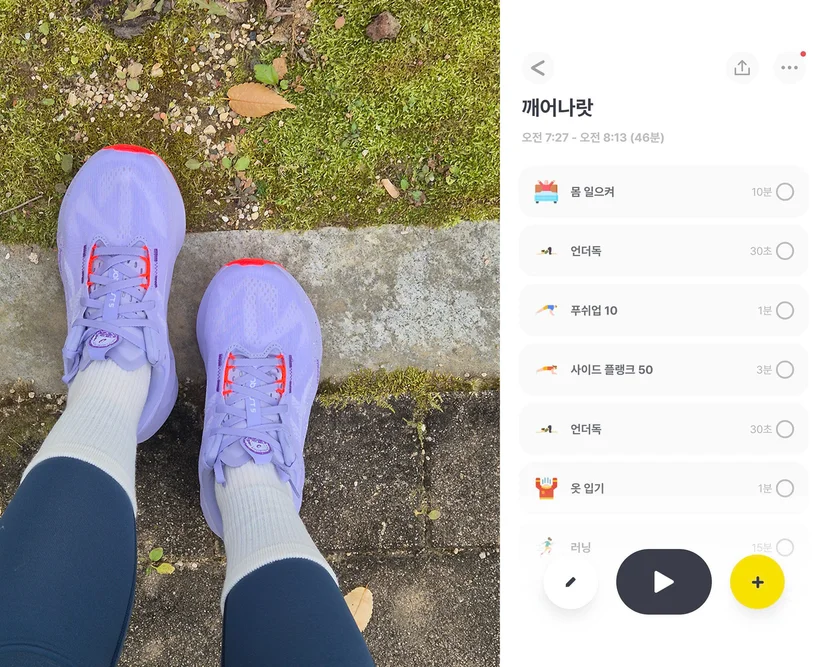
Dina's routine
Dina’s “wake-up” routine begins with morning stretching. As soon as she opens her eyes, she moves into a downward dog stretch, followed by push-ups and side planks to fully wake her body and mind. With the quiet satisfaction of having already done something productive for herself, she then heads out for a run. She says that completing her run makes the entire day feel different. It has helped her manage her emotions more effectively as well.
Dina describes herself as someone with abundant energy, endless thoughts, and a high sensitivity to external stimuli. Her emotions run deep, and even small words or gestures from others can sometimes feel overwhelming. But while running, she feels momentarily free—from thoughts, from stimuli, from emotional noise.
Of course, difficult memories do surface at times. Yet the physical effort of running demands so much energy that far less remains for emotional exhaustion. It feels, she says, like discovering a “cheat code” for emotional regulation.
Anyone who has tried to maintain a daily exercise routine knows how difficult consistency can be. When it is hot, cold, raining, or simply uncomfortable, even getting out of bed can feel like a challenge. So what is Dina’s secret to sticking with her running routine?
“Just do it—without thinking,” she says. Once you start reasoning with yourself, you begin collecting excuses: It’s too cold today. It’s raining—maybe tomorrow. Overthinking, she believes, is often the fastest way to stop altogether.
Add Dina’s routine on Routinery →
Part 3.
Routinery Is My Personal Time Coach
Routinery’s timer works on the same principle. It removes the need to decide what to do next and simply guides you forward. Dina’s favourite feature is the timer itself. Living with ADHD, she often struggles with time awareness. In the past, following her thoughts and emotions too freely led to frequent lateness in the mornings.
With Routinery, time becomes visible. Tasks flow one after another, and her mornings feel structured rather than rushed. She says it feels like having a personal time coach—someone who tells her what to do, how fast to go, and what she might be missing. Thanks to the timer, she can move first and think later, both in her routines and in everyday life.
Everyone processes emotions differently. Some write. Some breathe. Others move their bodies. What matters most is finding a method that works for you—one that keeps emotions from taking over entirely. If your thoughts feel heavy and overwhelming, perhaps it is worth trying something simple: stand up, move a little, and let your body lead. Sometimes, action matters more than contemplation.
Did this story resonate with you, even just a little? We’re always looking to hear more real stories from Routinery users. Your routine doesn’t have to be perfect — it just has to be yours.
Turn this into a daily routine with Routinery.
Step-by-step timers and cues that make routines stick.
Build your own routine on Routinery → →